Category Archives: Blog

Moving away from Psychology Today, to Psychology Tomorrow…

Having subscribed to Psychology Today magazine, and advertised in its therapist directory for several years, I have recently ended my subscription. Despite it being one of the largest search engines for therapists, helping many people find a therapist, I find the ethos of the Psychology Today magazine antithetical to my own understandings about therapy and health. Psychology Today’s magazine tends toward over-simplifying the complexity of human experience, and, shamefully, over-pathologizing “symptoms”. (I should add that there are some very good blog postings from individual practitioners who are listed on the site, including my colleague and friend, Dean Olsher, who is writing about music therapy so beautifully).

Instead, I have come across a marvelous resource for therapists and clients alike – the Psychology Tomorrow Magazine, which has a directory of therapists of its own, the Alternative Therapists Directory.

As it states in it’s vision statement, the :

…Alternative Therapists Directory challenges the overzealous trend in psychology toward legitimizing itself through quasi-scientific labels that categorize and codify all human behavior, often with research funded by pharmaceutical companies. Instead, we understand that “symptoms” are inherently creative, subjective solutions to life’s innumerable dilemmas that sometimes bring unwanted consequences, and that there are many creative ways to intervene to improve people’s life choices.

In the current edition, you will find a thoughtful and inspiring column entitled Psychology’s taboo against the imagination written by Stanley Siegel, who is Editor-In-Chief of the magazine. I urge you to read it, and look through the other columns and creative endeavors, including explorations in poetry and art.

Trauma-Informed Guided Imagery and Music

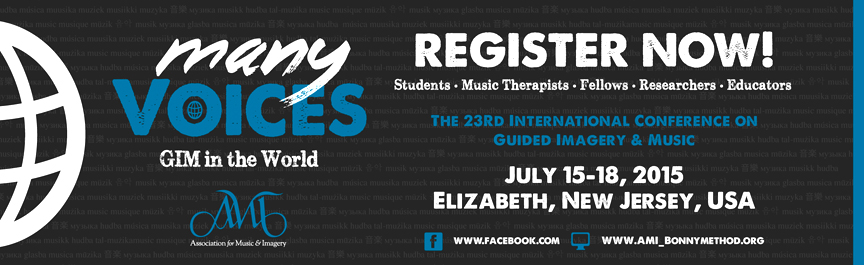
On July 16, 1:30-3:00pm, Erin Montgomery and I will be presenting at the 23rd International Conference of the Association for Music and Imagery in Elizabeth, NJ. Our presentation will explore Judith Herman’s phase-oriented model of working with trauma as it relates to a developmental model of Guided Imagery and Music: Supportive GIM for Safety and Stabilization; Re-educative GIM for Trauma Processing; and Reconstructive GIM for Reintegration. We will share clinical examples from each phase of treatment.

My colleague, Erin Montgomery, MEd, MTA, RCT-C, FAMI, is a music therapist and counseling therapist living and working in Halifax, Nova Scotia. She completed her GIM training at the Institute for Music and Consciousness and studied trauma-informed therapeutic approaches through the Boston Trauma Center at Justice Resource Institute, the Cape Cod Institute and the Traumatology Institute in Toronto.

For more information about the conference, please click on the embedded link, above.

Print

Art as Non-Performative

Savion Glover was at the Joyce Theater in New York City this summer. I didn’t know anything about his production, “Om,” but had seen him perform before and was willing to be completely surprised. And I was.

The curtain opened on a stage filled with pictures of religious figures and tap dancing icons, surrounded by candles and items of special significance such as religious texts or seminal music albums. There were also five or six individuals who sat and meditated on the stage throughout. Savion Glover danced for close to ninety minutes without stopping moving. His eyes were closed throughout, as were the eyes of the others as they danced their solos. This was dance and music as meditation, as prayer, as internal experience.

Even though the iconography on the stage felt heavy-handed at first, it made increasing sense to me; Savion Glover was inviting us, the audience, to experience the dance as the “performers” were. He was inviting us to experience the dance, not as separate spectators, but as equal participants in an experience of contemplation, and potential transcendence.

With the stage thus set up he was inviting us to not clap or praise the dancers as one might be inclined. It felt almost too sacred to clap (although people did at the end), and this seemed to be exactly the point. And so for the first time, I experienced dance as the dancer must experience it at times – as inner experience; as a practice of inner contemplation, personal communication, and meditation.

This is certainly how I experience the arts in the comfort of my own living room, or the comfort of my own music therapy office. I had never before witnessed dancers capturing so clearly the ways that I understand music as a human resource for health and wellbeing. Savion Glover didn’t so much perform, as demonstrate the resourceful qualities of dance and music. The dancers were there to bring us into their internal experience of prayer, supplication, praise, and joy in the music-dance; the closest example I’ve witnessed of art, not for performance, but for art’s sake.

Overheard: a comedian feels sad

The comedian Louis C.K. appeared on the Conan O’Brien show last year. I think his reflections on the damaging effect of cell phones on the developing empathy in children, went viral for a while.

When I first watched the clip, I felt completely in awe of this man. He beautifully describes experiencing the thing that is most difficult for the majority of my clients: letting oneself experience the fullness of a feeling, especially sadness.

He’s driving in his car and a Bruce Springsteen song comes on the radio. He hears a “faraway” quality to Springsteen’s voice that connects him to a deep, existential loneliness, and a sadness wells up inside of himself. He describes his immediate compulsive desire to text loads of people, as a defense to the feeling. And then he makes a clear and conscious decision to not reach for the phone. He describes pulling over his car, and surrendering to the sad feeling, allowing himself to sob as the song played to its completion. He experiences himself as alive – he recognizes the extreme beauty of feeling a sad feeling to its completion,  and the gift of a full, well-felt, life.

I am totally moved by his courage in describing the beauty in deeply-felt emotions, on a live, national, comedy show. This type of emotional maturity is foreign to a lot of people, and many clients come to psychotherapy precisely because they don’t know what to do with their emptiness or their sad feelings, and because they are afraid of really, truly, feeling anything.

What’s great about Louis C.K.’s story is that he models how we can all make a simple decision – a decision to be aware of our feelings, notice out defenses as they arise, decide in favor of the feeling though we know it will be hard, and then reap the reward of feeling really alive, and perhaps even joyful, as he did.

And if you can’t do this alone, because you have difficulty regulating your feelings when they arise, make an appointment and do this with a therapist. One of the main benefits of psychotherapy is emotional regulation (having and surviving your feelings), and just listening to music and allowing it to affect you, can be a wonderful way to practice just that.

A healthy music performance

Back in September, some generous and thoughtful friends invited me to the Opening Gala concert at Lincoln Center: a performance of Alan Gilbert conducting the New York Philharmonic. Yo-Yo Ma, Michael Ward-Bergeman (incredible accordian player), and Jamey Haddad and Cyro Baptista (both mind-blowing percussionists) were soloists on the bill.

There is nothing quite as powerful and moving as a live symphony orchestra. And the NY Phil, under this fine conductor, has to be among one of the best in the world. I was ten rows from the stage, could see every expression of joy and encouragement on Yo Yo Ma’s face, was mesmerized by Alan Gilbert’s movements, and experienced shivers down my spine on several occasions, which is no small feat.

What stood out?

Yo-Yo Ma is so good that he risks sounding ugly. He takes musical risks like no one else I’ve seen – with complete absorption and pleasure in the music he and his fellow musicians are making. It’s authentic. And that’s why he is the most famous classical musician alive or dead (I have no data to back this up, but it has to be true).

I can’t help it: when I listen to live music, I think of the health of the performer. I like to think that Yo-Yo Ma is an emotionally and psychologically healthy human being. Why? Because I hear and see it in his playing, and in the way he invites others into his musical world with a smile of encouragement, or a gaze of appreciation. He invites risk taking and even imperfection (in my opinion, an essential part of every live performance that makes the music alive and touching). He has enough skill, and enough confidence, that he is not proving himself – he is deeply inside the music, and believes so fully in what he is doing. And the sound that he makes cannot be described in words, although I’ll try – sweet, shivering, wailing, helpless, bounding, terrible, filling, inviting, passionate, full, crying, joyful, reckless. He has access to many states of being within him, and you can hear his rich inner world in his music.

I loved watching and listening to him more than I’ve loved a lot of things lately. And then the performance ended, and he and everyone else took a bow. And I saw the difference between the soloists and the orchestral musicians. I was right in front of the second violin section (which Gilbert places on the right of the orchestra), and not one person cracked a smile during the standing ovation for the second piece…or the third…it was only after the last piece that a saw a couple of smiles, presumably because they get to go home.

Not so for the viola section, led by Cynthia Phelps – she really appears to enjoy her job, seems to be completely absorbed in the pleasure of the music, and she invites her section to follow suit. They really seemed to be enjoying it!

Now, I have sympathy for the poor second violinists – most orchestral musicians are overworked, exhausted, under-paid, and truly frustrated artists. The soloists get to be themselves totally; the orchestral musicians (especially toward the rear of the section) generally feel ignored, and unheard and they usually have zero creative agency. However, I think an important sign of health is a person’s ability to allow themselves to experience the pleasure of the art that they are hearing, or seeing, or even creating. Health is (and this is only part-definition) the ability to surrender to beauty despite other stressors, difficult life events, mental or physical “illness” etc. Granted, beauty is subjective, but there was a objective beauty about the experience, evidenced by the soloists and the audience’s experience. I wanted to shout to the second violin section: “Come to music therapy and I’ll help you feel pleasure again, in the wondrous music you’re making!” Oh, that some of them might read my blog!


I wish I’d written this.

It’s rare to come across a piece of writing that cuts through all the confusing language and technical descriptions and, in a qualitatively different way, gets to the essence of psychotherapy. I appreciate Martha Crawford’s writing skills, and her thoughtfulness around the questions of what therapists do and how therapy works. Click here to read about how “it’s the relationship”.


Imagining the world with music at our core: Part 4

On the last day of the conference, I was struck by how conference presentations are as much about the discussion that is generated, as they are about the content shared. This strikes me as especially important when we think about pedagogy in general – education should never be just about imparting facts, and should always be about inspiring thinking. And when we begin to hold firm to one way of knowing, we endanger this sacred tenet.

Socrates said that “Education is the kindling of a flame, not the filling of a vessel.” I hope that we, as professionals, teachers, therapists, and colleagues, remember this as we move forward in sharing our wisdom and experiences with others — let’s not be too attached to having people subscribe to our respective approaches, and allow others to grow and expand in many and diverse ways.

Imagining the world with music at our core — the theme for this year’s AMI conference — is an invitation that requires tremendous openness, space-making for cultural diversity, and encouragement of diversity of thought and practice.

Thanks to everyone who made this year’s Association for Music and Imagery conference so meaningful.

Imagining the world with music at our core: Part 3

It was a truly magical day here in rainy British Columbia. A day full of myth, depth, sophisticated ideas, feeling, and gorgeous musical offerings.

It began with a presentation called “A Mythic Gateway to Transformation and Living Life Fully in the Twenty-First Century: Journeying with Innana and Enki.” Leslie Bunt, from the U.K., and Margareta Warja, from Sweden, used poetry, dramatic play, and music to re-enact some elements of this ancient Sumarian myth.

They proposed that the cyclical story of Inanna — empowered with majesty and wisdom, going down to the underworld, shedding her powers and personas at each stage, dying, and being reborn — holds tremendous wisdom for the work we do as therapists, and especially in our work with the unconscious. The journey of descent into the unconscious is the work that we can do in our GIM practice.

Quoting from a translation of the myth, Leslie and Margareta spoke the words: “From the great above, she opened her ear to the great below.” What a wonderful metaphor for the GIM process – we invite our clients to open their ears to the music and travel deeper inside themselves, to the “great below”.

And then Leslie Bunt ended the day with a presentation called “Thresholds, Transitions & Silences in GIM: The ‘Gap’ of Hermes”. He brought our attention to the work and transformation that happens in silences, in spaces, and in rests; between pieces, within pieces, and after the music. And on that note – it is time to rest.

Imagining the world with music at our core. Part 2

Conference attendance is not just about the presentations. Often the most memorable and important experiences happen when you least expect them. I sat at breakfast with an entire table of new Fellows of the Association – one from Colombia, one from Spain, and two from Mexico. Guided Imagery and Music is reaching far and wide.

Santiago, from Columbia, was speaking about his country’s struggles, economically, politically, and psychologically. He was describing the plight of many children, who have been taught how to kill by 9 years old, in order to sustain guerrilla war. It would be easy to be fatalistic and cynical in the face of such terror, but Santiago spoke very simply – “I don’t know if anything can change, but I do believe in the change that can happen, on the inside; I believe that inner change is possible, and this may be the only way.”

His words were a wake up moment for me – a reminder of why I am here, and why I am passionate about the work that I do. From the outside, it may not look like peace work, it may not look political, it may not even look relevant to external life issues; but on the inside, it – the work that is being done through deep transformational processes in music-centered therapy – is perhaps the change that will change everything else. Idealistic? You bet.

Imagining the world with music at our core: Part 1

I arrived in the wee small hours of Tuesday morning, in downtown Vancouver. And am now situated in a small retreat center outside of the city, enjoying the peacefulness of nearby woods, and the sounds of birds outside my window. This is a perfect place to come together with fellow attendees of the biennial, North American, Association for Music and Imagery (AMI) conference. This year’s conference title is “Imagining the world with music at our core”.

Most of the approximately eighty attendants of this conference are either Fellows of the association, or trainees in Guided Imagery and Music (GIM). It is an intimate group, although people have come from the U.K., Ireland, Mexico, Columbia, Spain, South Korea, China and Australia, as well as from all over North America.

I am excited to spend several days learning from my colleagues, and expanding my connection to this amazing method of working. GIM training infuses all aspects of my work, from my understanding and use of music, to the way that I verbally guide clients, to my appreciation for and understanding of non-ordinary states of consciousness and the spiritual lives of my clients. Most of all, though, this method encourages listening; it acknowledges the power of deep listening, and how an attitude of surrendering to music within a therapeutic relationship, can transform our inner worlds.

I am truly honored to be surrounded by folks that carry the wisdom of this work into the world, and wish for more people to know about it. For this reason, I will be sharing some highlights from the conference in the coming days. Stay tuned.